Data Centers and Your Water
AI is booming. The infrastructure behind it is drinking billions of gallons of water. And the communities living next to it are finding out what that means — often too late to prove what changed.
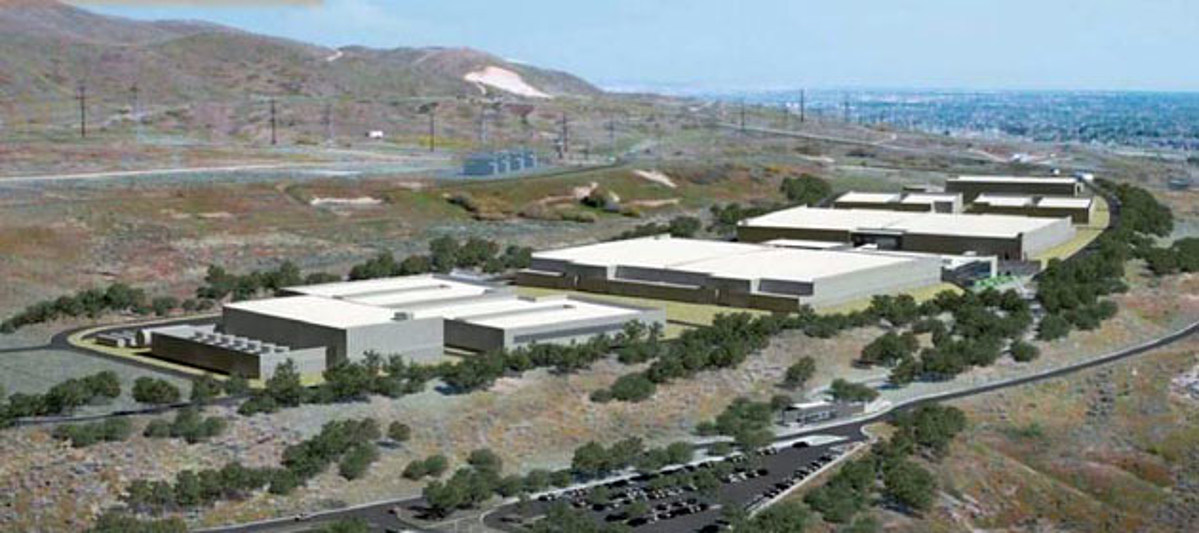
Aerial view of a U.S. data center campus — Photo: CC BY-SA 4.0 via Wikimedia Commons
The numbers
U.S. data centers consumed an estimated 17 billion gallons of water in 2023. That number is projected to double by 2028. A single large facility can use 1.8 billion gallons a year — as much as a medium-sized town.
The number of data centers in the U.S. more than doubled between 2021 and 2025, from about 2,600 to over 5,500. Google alone went from 4.3 billion gallons in 2021 to 6.1 billion gallons in 2024.
17B
gallons consumed (2023)
5,500+
U.S. data centers
80%
of cooling water evaporates
20%
discharged as chemical blowdown
Most of that water goes to cooling. About 80% evaporates through cooling towers. The remaining 20% — called blowdown — gets discharged as a concentrated mix of chemicals, dissolved metals, and elevated temperatures into local waterways or treatment systems. Sometimes directly into the ground.
What's already happening
Boardman, Oregon — Amazon/AWS
A town of 4,000 surrounded by 30+ data centers built since 2011. One resident's well tested at 52 mg/L nitrate — 5.2 times the legal drinking water limit — after three years of unknowingly drinking contaminated water. Amazon's defense: the contamination was pre-existing and “significantly predates AWS' presence.”
The data centers didn't put the nitrate in the ground — decades of agriculture did. But massive groundwater withdrawal concentrated what was already there by depleting the dilution buffer. In March 2026, Amazon agreed to a $20.5 million settlement — the first time a major tech company has paid damages for public health impacts linked to data center operations.
Canton, Mississippi — Amazon
A multi-billion-dollar AI data center campus with permit applications estimating nitrogen oxide emissions that could exceed 240 tons per year — roughly nine times higher than the nearby Nissan manufacturing plant. Residents in nearby neighborhoods reported dust settling over homes and playgrounds, traffic bottlenecks, and noise levels they weren't prepared for. Permits show the facility will house more than 700 diesel backup generators. Expansions continue despite community opposition and growing pressure from residents and local advocates calling for independent environmental review.
Newton County, Georgia — Meta
A couple living less than 400 yards from a Meta data center construction site reported their water drying up starting in 2018. Years later, two bathroom taps still don't work. The remaining water turned to gritty sludge filled with sediment. At a nearby 50-acre Meta facility in Mansfield, energy consumption spiked 34%, water usage increased by 200 million gallons per year, and surrounding residents reported severe well contamination and low water pressure. Newton County is on track to be in a water deficit by 2030.
Altoona, Iowa — Meta
About 200 gallons of diesel fuel spilled during routine generator maintenance in December 2025. An employee left a fuel cell open and walked away, causing a tank overfill. Twenty-nine tons of contaminated sand had to be excavated. One gallon of petroleum can contaminate one million gallons of water. A single large data center campus may have dozens to hundreds of backup generators, each with its own fuel supply.
In every case, the same pattern: by the time anyone noticed, there was no baseline data to prove what the water looked like before.
The missing piece
When contamination happens — whether it's groundwater drawdown concentrating existing pollutants, cooling chemicals entering waterways, diesel spills from backup generators, or construction runoff filling wells with sediment — the first question regulators ask is: what did the water look like before?
The answer, almost everywhere, is: we don't know. Nobody was measuring it. State monitoring programs visit most water bodies on multi-year rotations. If a data center starts operating between visits, there's no record of what changed. The company's defense — “pre-existing condition” — becomes nearly impossible to challenge without data.

The water these communities depend on. Photo: CC BY 2.0, Chad Fennell / Eco84 via Wikimedia Commons
Nemo's Eye is built to fill that gap. Continuous, GPS-tagged, timestamped water quality readings — temperature, dissolved oxygen, clarity, depth, pressure — collected automatically, at the actual water body, around the clock. Not a lab sample taken once a year. A living, ongoing record that captures the before picture so the after picture has something to compare against.
What's coming
States are starting to respond. South Carolina's Data Center Responsibility Act (HB 4583) would require closed-loop cooling systems with zero net water withdrawal. Kansas (SB 400) would allow municipalities to sue data centers that violate water protections. Arizona has made new groundwater certificates nearly impossible for hyperscale projects.
But regulation follows damage. The communities already living next to these facilities — disproportionately communities of color, according to proximity studies — need data now. Not in three years when regulations catch up.
The technology to collect that data at scale, continuously, at consumer prices, already exists. It's the same platform that helps anglers fish smarter. It just needs to be deployed where it matters most.
The data needs to exist before the damage does.
Nemo's Eye puts continuous water quality monitoring in the hands of the people who live on the water — at a fraction of the cost of traditional instrumentation.
Join the Waitlist →Sources
- Environmental Law Institute — AI's Cooling Problem
- EESI — Data Centers and Water Consumption
- Rolling Stone — How Oregon's Data Center Boom Is Supercharging a Water Crisis
- Rolling Stone — Amazon $20.5M Settlement
- Food & Environment Reporting Network — Amazon Settlement
- Oregon Capital Chronicle — Amazon Nitrate Pollution Settlement
- Arkansas Democrat-Gazette — Canton Subdivision Struggles
- Mississippi Today — Amazon Data Center Investments
- Inside Climate News — Georgia Data Center Boom
- PPC Land — Newton County Water Impact
- WHO13 — Altoona Diesel Spill
- SC Legislature — HB 4583 Data Center Responsibility Act
- MultiState — State Data Center Water Legislation Tracker
Disclaimer
The information on this page is compiled from publicly available news reports, government filings, court records, and peer-reviewed research. All sources are cited inline and listed above. This content is provided for informational and educational purposes only and does not constitute legal, environmental, or scientific advice.
Nemo's Eye and 10th Street Ventures LLC do not make independent claims of wrongdoing, liability, or regulatory violation against any company, agency, or individual referenced on this page. Where allegations, lawsuits, or regulatory actions are described, we are reporting matters of public record as documented by the cited sources. Settlements referenced do not constitute admissions of fault or liability unless explicitly stated by the parties involved.
Water quality conditions, regulatory landscapes, and legal proceedings described here are subject to change. Information is current as of the date of the cited source material. Readers should consult the original sources and qualified professionals for the most current information and before making decisions based on this content.
Nemo's Eye is a water quality monitoring platform. The environmental data collected by Nemo's Eye sensors is raw observational data contributed voluntarily by users. It is not a substitute for certified laboratory analysis, regulatory compliance monitoring, or professional environmental assessment.